
4
Managing an enterprise social media presence used to be a manageable, part-time endeavor. A team could draft a handful of updates, log into a platform or two, and hit publish whenever convenient. Today, that informal workflow has completely collapsed under the weight of an always-on distribution landscape. Modern marketing departments are expected to maintain an active, tailored presence across half a dozen distinct networks, each governed by its own algorithms, publishing standards, and audience expectations.
Left unmanaged, the sheer mechanics of posting—toggling between accounts, resizing assets, manually formatting copy variants, and monitoring comments around the clock—turns into an exhausting administrative grind. Marketing teams often find themselves trapped in a cycle of reactive execution, spending their best hours moving files around rather than crafting compelling campaigns.
Social media automation provides the architectural framework needed to break that cycle. When deployed with strategic discipline, automation is not an impersonal substitute for human creativity; it is the operational backbone that frees marketers to focus on narrative, community building, and measurable business growth.
Reclaiming Cognitive Bandwidth for High-Impact Creative Work
The most expensive byproduct of manual social management is the fragmentation of creative focus. High-performing marketers do their best work during uninterrupted blocks of concentration—conducting qualitative customer research, studying competitive narratives, testing new visual styles, and developing original brand perspectives.
When a marketer must pause every two hours to publish a graphic or check an engagement queue, their day splinters into micro-tasks. That administrative friction drains cognitive energy. Batch processing through automated workflows allows teams to design, write, and schedule weeks of content in focused, deliberate sessions.
Once the baseline publishing calendar is locked into a scheduling engine, the day-to-day pressure dissipates. The team regains the mental space required to capitalize on trending conversations, experiment with long-form storytelling, and collaborate closely with product and sales teams on joint initiatives.
Ensuring Channel Consistency Across Dispersed Time Zones
Social platforms reward consistency. An account that publishes sporadically struggles to train algorithmic feeds or build predictable consumption habits among its followers. Yet maintaining a steady cadence by hand requires either constant vigilance during standard working hours or unreasonable demands on employees during evenings, weekends, and holidays.
Furthermore, most brands now speak to an audience dispersed across multiple time zones. What represents mid-morning engagement in New York is the middle of the night in London or Sydney.
Automation removes human availability from the distribution equation:
-
Algorithmic optimization: Intelligent scheduling engines analyze historical engagement trends to deploy assets precisely when specific audience segments are most active, rather than relying on arbitrary posting guesses.
-
Cadence reliability: Content flows without interruption regardless of illness, vacation schedules, or internal meetings, establishing a predictable brand presence that users rely on.
-
Tailored distribution: Teams can customize a single core message for LinkedIn, X, Facebook, and Instagram simultaneously, adapting copy length and visual formats inside a centralized dashboard before scheduling each variant to go live at its respective peak hour.
Transforming Community Management from Chaos to Cohesion
Publishing content is only half the mandate; the real equity of social media lies in conversation. However, monitoring notifications across several fragmented native apps virtually guarantees that important inquiries slip through the cracks. Customer complaints sit unaddressed, prospective buyers lose patience, and positive community sentiment goes unacknowledged.
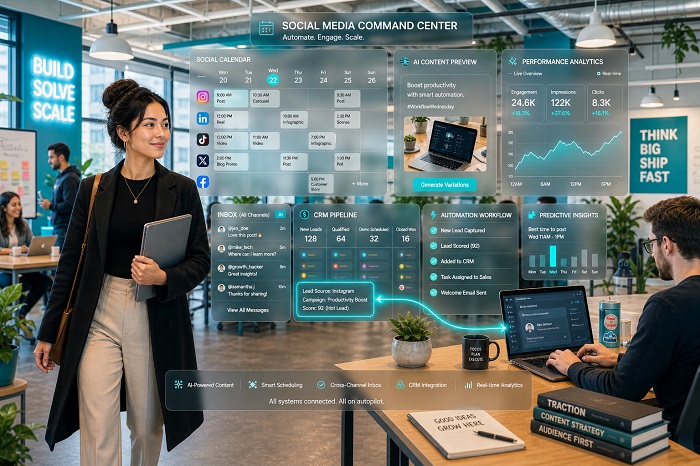
Social automation tools address this by establishing unified social inboxes that pull every direct message, comment, and public mention into a single operational interface.
Streamlined Routing and Rapid Triage
Not every incoming notification carries the same weight. A user complimenting an Instagram graphic requires a brief, friendly acknowledgment, whereas a prospective client asking about enterprise pricing warrants an immediate alert to sales.
Automated triage rules automatically scan incoming interactions for specific keywords, sentiments, or user account tiers. The system can assign incoming messages to specific team members based on territory or expertise, tag potential customer support issues for technical escalation, and trigger canned response suggestions for repetitive inquiries like business hours or policy links.
Protecting Brand Reputation Under Pressure
During unexpected PR crises or sudden product outages, incoming message volume can spike by several hundred percent in minutes. Manual tracking inevitably breaks down under that load. Automated listening triggers can detect sharp increases in mention volume or sudden shifts in brand sentiment, sounding an early alarm before an issue balloons into a public relations emergency.
Eliminating the Pain of Manual Analytics and Reporting
For many marketing managers, the end of the month means hours lost to manual data gathering. Exporting separate spreadsheet files from multiple native dashboards, standardizing engagement metrics, and pasting numbers into static presentation slides is tedious, error-prone work that yields very little actionable insight.
Automated reporting infrastructure removes the manual labor from performance evaluation:
-
Unified metric aggregation: Cross-platform metrics are continuously collected, normalized, and displayed in dynamic dashboards, offering a comprehensive view of overall reach, engagement rates, and referral traffic.
-
Automated stakeholder delivery: Customized executive summaries can be scheduled to arrive in stakeholder inboxes on a weekly or monthly basis, keeping leadership informed without consuming billable hours.
-
Real-time content diagnostics: Automated performance triggers can alert teams when an asset is performing significantly above average, allowing them to quickly allocate paid advertising budget behind an organic post while momentum is high.
When data flows automatically, teams transition from merely reporting what happened in the past to actively diagnosing what should happen next.
Institutional Governance and Risk Mitigation
As marketing departments expand, bringing in external agencies, freelance copywriters, and junior coordinators, the risk of human error escalates. Handing out native login credentials to multiple individuals creates substantial security vulnerabilities and invites catastrophic mistakes—such as accidental personal posts on a corporate handle or publishing unapproved copy.
Automation platforms serve as a secure governance layer. Native account credentials remain securely vaulted with system administrators, while contributors work within controlled permissions.
Configurable approval chains ensure that junior team members can draft posts without possessing publishing clearance. Drafts move automatically to an editor or brand manager for review before entering the active queue. Furthermore, centralized emergency controls allow a team to pause all scheduled output across every channel with a single click if breaking news or an internal development makes pre-written content tone-deaf.
Cultivating Sustainable Marketing Operations
The modern digital ecosystem offers no shortage of noise. The marketing teams that cut through that noise are not the ones spending forty hours a week manually pressing buttons on a smartphone; they are the ones who treat their time as an asset and build operational leverage.
Social media automation is not about stripping the personality out of your channels. Quite the opposite: by handing off the mechanical, repetitive, and administrative tasks to software, you give your team the time, energy, and mental clarity required to show up with genuine humanity where it matters most.
